Curatorial Projects
Raíces/roots:
camilo loaiza bonilla
Scarfone/hartley gallery
The university of tampa
August 28 - october 14, 2025
This solo exhibition showcases a new body of work by visual artist and poet Camilo Loaiza Bonilla (b. 1998, Colombia). Bonilla crafts experimental work that transcends media and genre. This immersive exhibition centers on eight new, experimental video poems by the artist as well as interactive digital games and a curated reading nook. While deeply tethered to the artist’s personal journey as a queer, trans first-generation immigrant, all of these works conjure larger questions about what it means to confront intergenerational trauma; how memory work can engender and complicate forgiveness; and how poetics—digital and analog—can forge a path for authenticity, belonging, and healing.

Still image from Camilo Loaiza Bonilla, Raíces, 2022/2025. (c) Camilo Loaiza Bonilla.
The kingdom of this world, reimagined
university art galleries,
university of pittsburgh,
and carlow university art gallery
August 2023 - march, 2024
pensacola museum of art
september 2021 - january 2022
satellite gallery of the
little haiti cultural center
december 2019 - january 2020
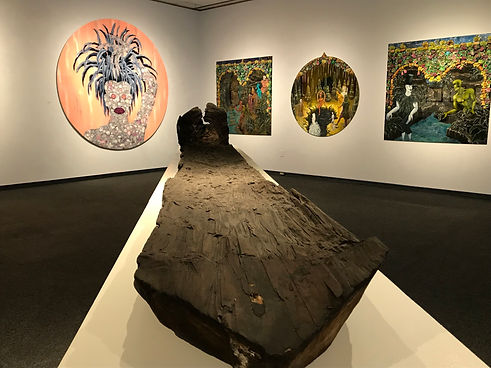
This exhibition presents a selection of contemporary work inspired by Alejo Carpentier’s mytho-historical book, The Kingdom of this World (originally published in 1949), which recounts the Haitian Revolution and its profound impact on the emergent nation. Originally presented in Little Haiti, Miami, on the occasion of the book’s seventieth anniversary, an international cohort of artists, each with ties to the Caribbean, responds to Carpentier’s innovative retelling of the extraordinary, true events of Black liberation, struggle, spirituality, and knowledge in colonialism's wake.

Edouard Duval-Carrié, The Kingdom of This World, 2017. (c) Edouard Duval-Carrié
layered voices:
process and paper in contemporary native american art
landmark gallery
texas tech university
february - may 2020
This exhibition features seven Native American artists whose work in printmaking, drawing, and collage/assemblage asks us to explore, in medium and message, the depths of selfhood, community, and modernity in Native American arts today. Though distinct in their techniques and styles, these works all share in the common goals of environmental and social justice, cultural awareness, and a desire to disrupt entrenched Eurocentric narratives about artistic production and Native identity in the modern world. The diversity presented here—in imagery, techniques, media, and tribal affiliations—resists the fictive narratives of cultural homogeny and stasis that have been cultivated throughout 500 years of European occupation of Native lands in this hemisphere. Work by Native American artists in the US today reveals a wealth of multifaceted identities and varied means of expression. While these pluralities have long been extant, Native American artists have had limited platforms for visibility in prevailing narratives of art in the US—a nation built upon the labors and exploitations of enslavement, settler colonialism, and the marginalization of people of color. The complex realities of these shared histories, which have been experienced with striking differences between Native communities and by immigrant settlers, continues to inform how identity today is constructed in, and fractured across, the US. The artists in this exhibition have approached these irreconcilable tensions of past/present, insider/outsider and Native/Western from distinct vantage points, each questioning how historical circumstances shape our contemporary fields of vision and attitudes toward culture and identity. Nonetheless, these artists each acknowledge these fractures, pluralities, and tensions as a mark of our shared humanity.

Mikayla Patton, For the sake of her, 2019. (c) Mikayla Patton.

decolonizing refinement: contemporary pursuits in the art of edouard duval-carrié
co-curated by paul niell and michael carrasco
museum of fine arts
florida state university
february - april 2018
This exhibition features the contemporary multimedia arts of Edouard Duval-Carrié coupled with historical artifacts from local Tallahassee-area collections. Our principal aim is to improve and expand understanding of Caribbean visual culture and the arts of the African Diaspora by implicating the colonial heritage of north Florida and the broader U.S. Southeast in circum-Caribbean histories. In this manner, we employ Duval-Carrié’s recent works, which critique the Francophone history of Caribbean representation, as agents of “decolonization.” By decolonization, we refer to the recognition that modernity is inextricably linked to the legacy of colonial institutions as they existed historically and as these systemic conventions extend, often unnoticed, into today. To “decolonize refinement,” then, signifies our desire to draw attention to the oppressive processes utilized by colonial powers to “purify” products, such as cotton and sugar, in the service of global commerce. We wish to foreground the ways in which this history of oppression, enslavement, and invisible labor served the modern hunger for conspicuous consumption, particularly in terms of the visual and material culture this “consumption” necessitated. Duval-Carrié’s individual works tackle this subject to decolonial ends, particularly as it pertains to the Caribbean world. Through this exhibition, we seek to build upon Duval-Carrié’s artistic statements to demonstrate how these problematic processes likewise extend to Florida’s visual and material culture.
as cosmopolitans
and strangers:
mexican art of the jewish diaspora, selections from the permanent collection
national museum of mexican art
january - august 2014
“As Cosmopolitans and Strangers” takes its title from the work of Jewish Mexican scholar Adina Cimet, who has studied the double consciousness of Diasporic communities as both insiders and outsiders, cosmopolitans and strangers. Over time, Cimet argues, subsequent generations begin to lose this cultural memory of assimilation, becoming “partial strangers to their own strangeness.” This exhibition explores Cimet’s claim of “strangeness” and the struggle between preservation and integration in the Jewish Mexican community. While the experience of Jewish heritage may differ for each artist in this exhibition, they are united through the phenomenon of Diaspora and the experience of immigration. Can cultural memory persist in the face of assimilation? The works in this exhibition—spanning the 20th and 21st centuries—reside in the NMMA’s permanent collection and provide a unique opportunity to challenge established notions of mexicanidad. These artists of Jewish heritage have been integral to the evolution of a modern Mexican visual culture, yet the voices of this minority have yet to be fully incorporated into the global perception of Mexican identity. The diverse experiences that have cultivated Mexican identity raise questions of citizenship and immigration that resonate now more than ever. As explained by Jewish Mexican art historian Anita Brenner, “It is that nowhere as in Mexico has art been so organically a part of life, at one with the national ends and the national longings.”
